Thursday, November 25, 2010

Caves and cities

BLDGBLOG recently pointed to a survey of the caves under the city of Nottingham.  Using laser imaging, they are producing incredibly detailed 3D maps of caves that have been dug into the sandstone beneath the city.  The caves range from Medieval escape routes (such as Mortimer's Hole), to Victorian “gentleman’s caves” (enlarged cellars where they could host dinner parties).  But all were dug out rather than natural – something that was possible because the stone beneath the city is stable but comparatively soft.

Mortimer’s hole is particularly interesting because it is the real deal for fantasy gamers.  This is what a tunnel from the middle ages really was like, and I must say it’s not far off what is often portrayed, at least from the older versions of the games.  It’s a little narrower than was conventionally drawn (the tyranny of the 10’ squares, I suppose), it’s steep, it’s twisty, and there’s a couple of side passages along the way.
Mortimer’s Hole–via the Nottingham Caves Survey

And look at this drawing of the cave from 1934, it could easily have come from some Gygax-era D&D product.


Drawing by Edward Flewitt from The Forest Fortress, via the Nottingham Caves Survey

A nice example of a gentleman’s cave is 13 Newcastle Drive.  A much smaller and more recent cave, it’s essentially the cellars of a merchant’s houses from 1864 – just the thing for a Cthulhu gaslight game.

13 Merchant Drive

This reminded me of an earlier story on BLDGBLOG, of the caves beneath the city of Naples.  Like Nottingham, they have been dug out, and over a period of millennia.  As happens when you are surrounded by history (so I hear), much of them have been forgotten or lost, and they are now being re-explored by the University of Naples.  According to this report from the BBC, so far they have mapped 900 caves covering about 1,000,000 square metres (roughly 10,000,000 square feet, or 100 hectares), and believe that there is twice that still left to uncover.


Photograph from 1944 issue of Life magazine


Interior of one cave from a proposal to build an underground flower factory, via BLDGBLOG.

The mysteries that could be hidden under a city have been gaming fare for a long time, of course, but it’s fascinating to see real examples of these things.  I’m particularly impressed with the size and scale of the ones from Naples, they are truly cavernous.  And largely lost and forgotten, who knows what they could find down there?  Could a team of anthropologists working at mapping out the subterranean levels of a city stumble on something unexpected, something best forgotten?

Thursday, November 18, 2010

Rainforest insects macro photographs


An Assassin Fly (aka Robber Fly) feeding on a Cranefly; photo by Mark Berkery.

Mark Berkery is an Englishman now living in Australia who is steadily producing a very fine collection of macro photography.  His focus is on the insects of the Australian rainforest and his images combine incredible sharpness with fabulous, saturated colours.  Here is a small sample from his site to whet the appetite.


A beetle with an almost human face; photo from Mark Berkery

The head and tail of a centipede; photo from Mark Berkery


Wasp emerges from a branch; photo from Mark Berkery

Macro photographs like these (especially when you view the full-size versions) make it much easier to see the old fantasy game staple of giant insects as legitimate threats.  Imagine going eye-ball to eye-ball with that Assassin Fly, or facing a wasp the size of a cat.  The “giant centipede” has always struck me a vaguely comical, but when you look at them properly they look otherworldly and alien.

Wednesday, November 17, 2010

Glowing trees, a thousand blooms


Trees, but not actually glowing ones; image via Engadget

A pair of interesting plant related stories came out recently.  First, researchers in Taiwan reported that they were able to stimulate plant’s leaves to produce a red glow.  Their work involved infusing the leaves with gold nanoparticles, apparently shaped like sea-urchins and “dubbed nano-sea-urchins or NSUs”.  The researchers are hoping to refine the technique to the point that suitably treated street trees could replace street lights, so they clearly believe that the glowing trees are capable of producing a significant amount of light.

I love the idea of a town bathed in the light of their glowing trees.  Perhaps it’s actually part of the forest, the town is built right in the middle of a dense forest within a section of bio-luminescent trees.  Or a secret glade of trees, even a single special tree, that glows at night.  A sacred place, perhaps, with a temple of some kind and a gathering place for worshippers.  And it could work in either a futuristic setting (where it would be ecological high technology), or fantasy (druidic or elven mystical rites to ‘feed’ gold-dust to the trees).

Would the effect on the trees be permanent, or would they require constant replenishment to maintain their glow?  Would the people need a constant supply of gold to feed to the trees?  Would the trees be evergreens or deciduous?  If they’re deciduous, what happens to the leaves themselves – are they allowed to decompose and feed the trees again, are they worth something to a thief?  And if they’re deciduous, would that mean going without their light over winter?

The other story was of a master chrysanthemum grower who has produced a 1000-bloom plant.


The thousand bloom plant, via Gizmodo

The plant was produced by a long system of pinching and training the shoots, with the whole plant fitted into a metal structure to preserve the shape.  This doesn’t suggest some use to me beyond simply looking spectacular, but sometimes that is use enough.  Insert something like this into the halls of some royalty, or have this as one of these glowing trees – what if the flowers, rather than the leaves, glow at night?

Saturday, November 13, 2010

The Cave of Crystals


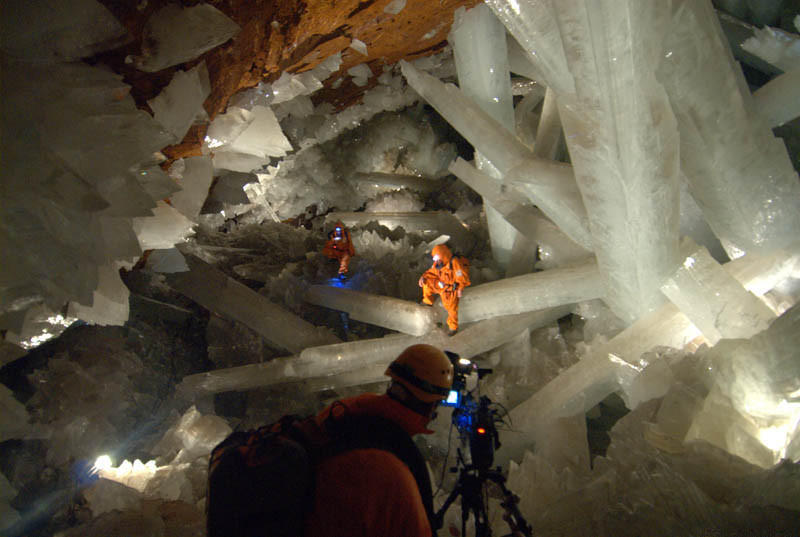
A film-maker walks among 10m long crystals.  All images from stormchasers.

The Naica Mine is a lead and zinc mine reaching some 300m below the surface of Chihuahua, Mexico.  In 2000, miners broke through into a chamber filled with gigantic crystals.

The cave was filled with hot, mineral rich water for the last 500,000 years.  That environment was ideal for crystal development, and the result are selenite (a form of gypsum) crystals that have reached 11m and more than 50 tons.

Mining drained away the water, but the cave remains a challenging environment.  A magma pool nearby keeps the temperature up at 58C (136F), with the humidity up over 90%.  These film-makers needed to wear suits to let them cope; their equipment struggled and the camera broke down at the end of the day.

A cave deep underground that looks like Superman’s fortress of solitude, that says adventure to me.  It also reminds me of Doctor Who’s visit to the cave of the Great One on Metebelis III.  Hmm, and that was a planet he first visited in a story arc revolving around a mine.

Beyond that, the idea that this was something stumbled on by miners is intriguing.  People toiling in already dangerous conditions break through to something unexpected – another cave or something else?  I wonder, what was it that happened to Juan Romero?

Friday, November 12, 2010

Into the unknown

Continuing this spate of posts on caves, a clutch of images from National Geographic.  Fine examples of the magazine’s long history of outstanding photography, all these photos leave me wanting to explore these places myself.  In an imaginary, make-believe kind of way rather than actually abseiling, of course.


Possibly Sotano de las Golondrinas


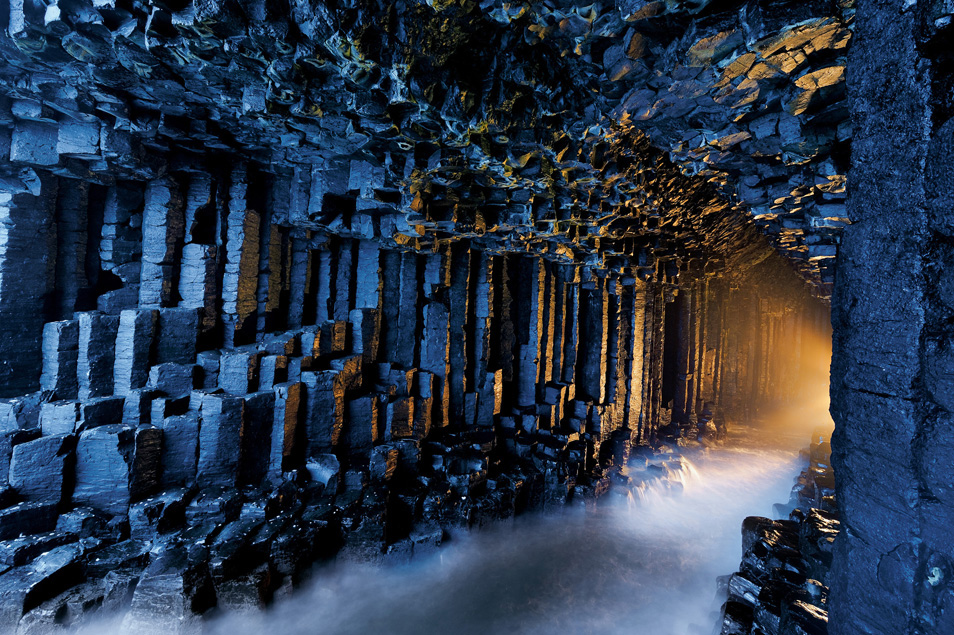
Fingal’s Cave, the outer Hebrides


Sotano de las Golondrinas, Mexico


Majalis al Jinn, Oman


Xkeken Cenote, Yucatan, Mexico

Isometric cave maps

While reading about caves with massive vertical drops, I found a some isometric maps of caves around Mount Velebit in Croatia.  First, Lukina Jama, the deepest pit in Croatia.


Lukina Jama, from the Croation Speleology Server.  Click through for full size.

At the bottom there is a system of ponds that houses one of the largest colonies of subterranean leeches.  Now, what exactly are those leeches feeding on (apart from lost explorers)?

The trogolobitic leech, Croatobranchus mestrovi.

Second, Velebita.  This has the longest single vertical drop – 516m.  I love that this map seems to have included diagrams of where the ropes go, and pictures of trees and boulders at the surface.  Are they like markers to help you find the place: “it’s easy to spot, there’s a big fir tree there and a rock that looks like Groucho Marx’s nose – you can’t miss it”.

Velebita
Small sample from the Velebita map, again from the Croation Speleology Server. Click through for full size.

These caves, and several others, are all clustered around the one location in the Sjeverni Velebit national park.  This cross-section shows just how close they are to each other – shades of the Caves of Chaos?


Cross-section, click through for full size.

The Miao Keng shaft


The 500m deep Miao Keng shaft, image via the Daily Mail.

The area around the mountain village of Tian Xing seems to have an incredible assortment of caves.  It has the four deepest cave systems in China and “numerous 200m+ vertical shafts” including the 491m Miao Keng shaft.  A half a kilometre (1600 feet, for the metrically challenged) of sheer vertical drop.


At the bottom of the shaft, the lights are the cavers’ headlamps.  Via Daily Mail.

The descent down this shaft takes hours, all performed abseiling on a single rope, and this particular team of cavers spent a week exploring the area.  As long as this drop is, it’s not quite the longest in the world: there are several in Croatia and Slovenia that are somewhat longer than it.

Those pictures of the descending cavers are spell-binding.  Descending a shaft like that must take some serious nerve, a real act of faith in the strength of your equipment.  Would your characters have what it takes to face a thousand foot drop into the unknown?  Would they even be able to deal with the logistics of traversing it?