Showing posts with label Frozen lands. Show all posts

Tuesday, February 1, 2011

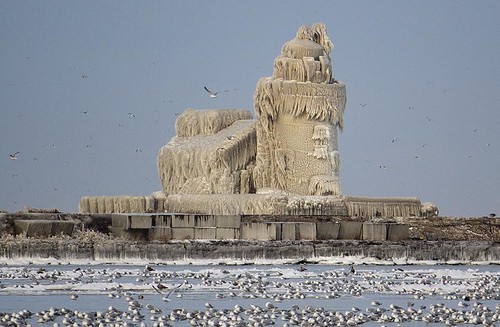
Cleveland’s frozen lighthouse

In December last year, freezing winds turned Cleveland’s West Pierhead lighthouse into a giant ice sculpture.  The wind drove waves against the lighthouse, covering it in spray which was then frozen in the intense cold.


Image from Albino ©'s Flickr stream.


Image from Albino ©'s Flickr stream.


Image from Albino ©'s Flickr stream.

Imagine a tower frozen like this as the result of some magic or magical creatures.  Was someone casting a great spell that had the unexpected side-effect of freezing the tower (perhaps with them in it)?  Was it frozen from outside to seal something within?

How might you safely enter such a place?  Are those icicles waiting like spears to fall on people?  Is it also frozen within the building, with treacherous icy floors?  Has the freezing caused the stone itself to become brittle, so that removing the ice too quickly (with intense heat or smashing it off) makes the structure even more fragile?

Saturday, January 29, 2011

Building with ice and snow.

On the subject of living in frozen landscapes, last year BLDGBLOG mentioned a fascinating thesis project from University of California, Berkeley student Taylor Medlin: Towards a new Antarchitecture.  First, the subject matter itself: making sustainable buildings in Antarctica out of ice. 


Datasheet comparing blocks of ice treated in various different ways.  Via Taylor Medlin’s Flickr stream.

Pure ice, crushed ice, or pykrete (ice infused with sawdust) and enhancing their strength with steel or glass rods were all examined as ways of building in Antarctica with the materials that are available there (ie ice and snow).

But for a game, I think that it is the presentation itself that is the most inspiring.  Medlin made a series of dioramas with wax human figures in ice structures and housed them in a glowing box surrounded by magnifying glasses and fish-eye lenses to view the scenes.  The box itself is covered with lazer-etched text and diagrams explaining the project.

The box containing the dioramas.  Via Taylor Medlin’s Flickr stream.

The dioramas themselves depict various scenes from hypothetical frozen buildings, from a world where buildings made of ice can be habitable by people.  Most of these scenes make particular use of ice being translucent – building out of ice would make possible special lighting effects that are not possible in stone or concrete.


A sampling of the dioramas.  Via Taylor Medlin’s Flickr stream.

The figures in these scenes seem to be looking around their world with a sense of interest, in some cases almost wonderment or awe.  Apart from this guy, he looks like he’s had about enough of these lights and he’s getting ready to dish out some hurt.

A miniaturized frozen world contained in a glowing box covered in cryptic symbols, that’s an idea that could work in all sorts of settings.  In a fantasy realm, it’s Glacial rift of the frost giant jarl meets Rob Kuntz’s Bottle City.  In a Cthulhu setting, the frozen box reminds me of both Cool Air, where the diorama scenes are rather like Polaris – a magical box created to preserve someone’s life by shrinking them into this cold dreamland, perhaps?  And in sci-fi, shrinking has been a staple for a long time (Fantastic Voyage, of course, and wasn’t there a Superman story arc involving a miniaturized city?); in that case, the diagrams on the box are technical displays from the computers running the system.

There are many options for how you might play with this.  Can the players travel into the box, and once there how do they get out?  The inhabitants of the box can be observed from the outside, but can they see out themselves?  Is it possible to communicate between the inside and out?  For that matter, is there actually any shrinking going on, or is the box actually a portal of some kind that allows you to view some faraway place?
Friday, January 28, 2011

Camp Century, a city in a glacier

In 1959, the US Army Corp of Engineers built Camp Century into glaciers in the far north of Greenland.  To do this, they dug broad trenches into the snow, put a corrugated iron roof over the top, and then covered that with snow for insulation.  Inside the trenches they could then build shelters or facilities for their work.


Camp Century during construction.  Both photos via Frank Leskovitch.


Map of the facility.  Again, via Frank Leskovitch.

It was a nuclear-powered research centre, with a particular focus on deep-core ice drilling.  They were the first to the bottom of the Greenland ice-sheet, reaching 4550 feet in 1961, and when you’re drilling so far below the ice, who’s to say what you will find?

Power came from a portable nuclear reactor (which sounds like something from Back To The Future), which was still part of an experiment.  Only eight were produced, and the Army’s nuclear power program was abandoned a few years later.


The portable reactor.

If a nuclear powered research centre in a glacier isn’t exciting enough, Camp Century was partly a proof-of-concept for Project Iceworm – a plan to develop a series of nuclear missile facilities under the arctic ice-sheet.  And then, to cap it off, in 1960 a pair of boy scouts were given the chance to be “Junior Scientific Aides” at the camp, spending five months living there (October – February, right through winter).

This would make an awesome setting for a golden era Doctor Who game (of course, transposing it be the British military) or an atomic era Cthulhu.  Combining the Greenland ice-sheet in winter with nuclear power and weapons does sound like a marriage of Pagan Publishing’s Walker in the Wastes with Pelgrane Press’s Castle Bravo.

Isolated in the arctic circle, have they accidentally disturbed something?  Or could it be that this is part of some plan to release something on the world?  Have a pair of boy-scouts been invited to this unlikely situation to provide sacrificial innocents (virgins being hard to find among the service men)?

Friday, January 7, 2011

Trango Towers

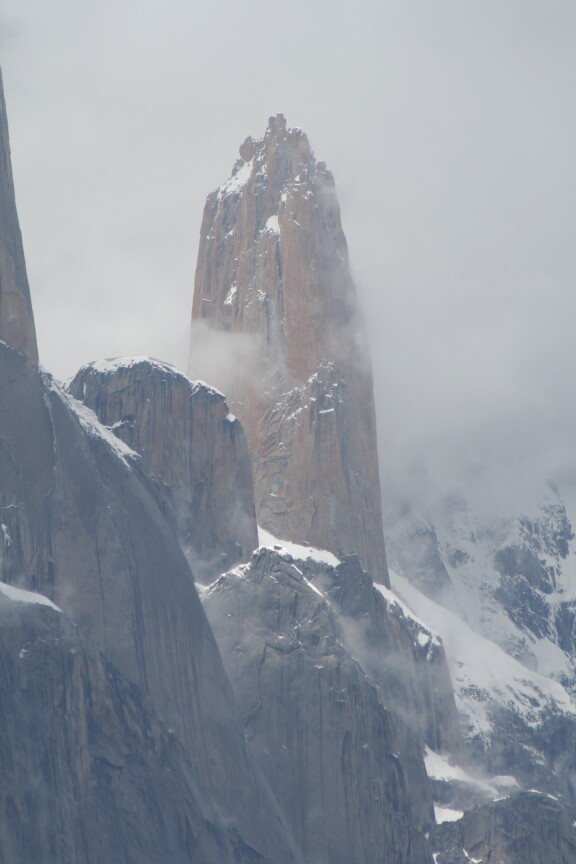
In the north of Pakistan, in the Baltoro Muztagh mountains and not far from K2, the Trango Towers feature several of the most significant granite cliffs in the world.  The eastern face of the Great Trango Tower, the highest peak in the group, features the largest “nearly vertical” drop in the world: 1,340 metres, but not with the true vertical drop of Mount Thor.


Looking across the Baltoro glacier, the Trango group are on the left of this picture.  Image via Evert Wesker.


Great Trango Tower.  Image via Askole treks.

The image of those towers rising up out of the Baltoro glacier is very impressive; especially when you consider that the glacier itself is up at 4,000m and yet they still rise a kilometre above that.  What really caught my eye was that among this group of mountains is one particularly striking peak with the equally striking name of Nameless Tower.


No attribution, but image found via these forums.


Image via Todd Skinner


Image via Todd Skinner

Anything that we might call ‘nameless’ immediately brings Lovecraft to mind.  Those towering cliffs all remind me greatly of scenes from Lovecraft’s The Dream-Quest of Unknown Kadath (I must get around to reading At the Mountains of Madness, which I imagine is rife with these places).  The Plateau of Leng and the mountains separating it from Inganok, the mountain Ngranek (although that was a solitary extinct volcano), even the great carved mountains that protect Kadath.  And there is also the granite island that was referred to as “that nameless rock”:

On the twentieth day a great jagged rock in the sea was sighted from afar, the first land glimpsed since Aran’s snowy peak had dwindled behind the ship. Carter asked the captain the name of that rock, but was told that it had no name and had never been sought by any vessel because of the sounds that came from it at night. And when, after dark, a dull and ceaseless howling arose from that jagged granite place, the traveller was glad that no stop had been made, and that the rock had no name. The seamen prayed and chanted till the noise was out of earshot, and Carter dreamed terrible dreams within dreams in the small hours.

That final image of Nameless Tower by night, with that lonely light peering out, gives me the distinct feeling of a place where people are not meant to be, where we are not welcome.  In a sense, the advances that climbing technique and equipment have made that allows them to scale all of these places – so that now the challenge is to find newer, more difficult ascents – has removed some of the feeling that people must have had in previous generations of places that were simply inaccessible, mysteries that could only be penetrated in the imagination.

Thursday, January 6, 2011

Mount Thor–the world’s tallest vertical drop

There are times when the landscapes in movies, art, or games give me the feeling that the artists and animators had too much time on their hands.  “Come on,” I think, “look at those ridiculous mountains.  Real mountains are impressive enough, why make them so unrealistic?”  And then you see something from our very own world that makes you realise that those images aren’t so fanciful after all.

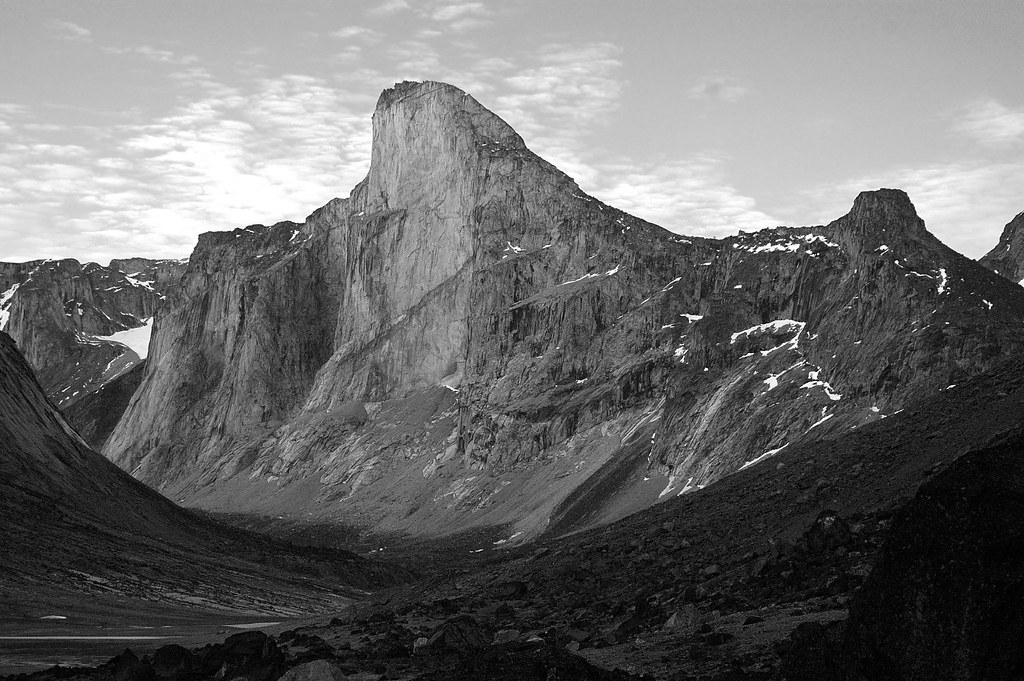
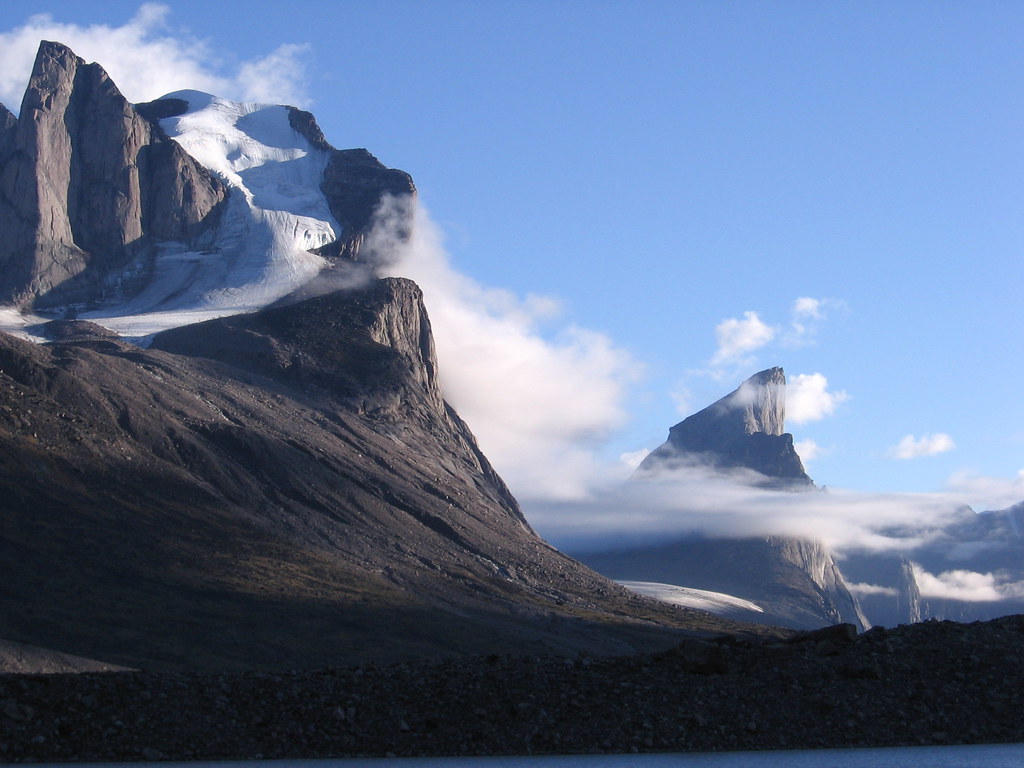
Mount Thor on Baffin Island (part of Nunavut in Canada) is a 1675m (~5500ft) granite peak that features the world’s tallest purely vertical drop.  At an average angle of 105 degrees, it is more than simply vertical – it is an overhang.  It cuts into the air like a mighty hooked thorn or knife, towering over the broad glacial valley below.


Mount Thor, viewed from the north (I believe)


Again, viewed from the north.  Note that the figures in the foreground are considerably closer to the camera than the mountain is.


Viewed from the south


Further back to the north, Nana Peak in the foreground.

The vertical drop totals some 1250m (4100ft).  Put in context, the Eiffel Tower is 324m, the Empire State Building is 381m, the CN Tower is 553m, and the Burj Khalifa 828m.

A magnificent prominence in a remote location, a wonderful setting for a game.  It would be a real challenge to bring the full sensation of this mountain to the table.  How do you make the players feel like they are under its shadow, or perched atop the peak?  Are words enough, or would it need pictures, or perhaps even a model?  If you put a 70cm tall clay model of the mountain on the table, then at that scale a 6ft tall character would be about 1mm.  Alternatively, if you’re playing with 28mm scale miniatures, Mount Thor’s drop is a little over 19m (64ft) tall – something like an eight-storey building.

Tuesday, September 7, 2010

The bleeding glacier

blood falls Photo by Peter Rejcek, from photolibrary.usap.gov

The Taylor Glacier in Antartica’s dry valleys sports a blood-red waterfall some five storeys tall.  As described at Atlas Obscura, the source is a lake that was trapped by the ice some 2 million years ago.  The lake’s water is very saline, which I presume is why it didn’t freeze, and rich in iron, which produces the striking colour.  The falls are the result of a fissure in the glacier, which allows the water to ooze out.  And perhaps most incredible of all, the lake is host to a colony of microbes still living there, without light, without (much) heat, isolated from the rest of the world for all that time.

The image of a glacier in a frozen landscape oozing blood is tremendously evocative.  Imagine in a place where the predominant colours are white, black, and grey, suddenly against a huge chalk-coloured wall of ice there is a brilliant red gash.  Equally evocative is the idea of a glacier as something that can keep something hidden for millions of years, literally for so long that there is no record or memory of it being there.

There are obvious connections to H. P. Lovecraft’s At the Mountains of Madness, or to movies like The Thing (based off John Campbell’s 1938 novella Who goes there?).  In each of these, something has ended up covered by ice by more-or-less accidental circumstances, what if something was deliberately sealed beneath a glacier?  In a fantasy setting, could some ancient creature or culture be deemed so wicked or dangerous that magical or divine powers bury it under the ice?  Now the ice thins and a danger long forgotten returns once more – would you need to find means to defeat it, or to replace the ice over it and bury it once again?