Showing posts with label Underground. Show all posts

Sunday, December 5, 2010

The cenotes of Yucatan

If you look at a map of Mexico’s Yucatan Peninsula, a keen eye may notice that although it is located in the tropics, and therefore receives quite a bit of rain in its wet season, there are no major lakes or rivers to speak of, especially to the north.  There is water there, though, flowing underground through aquifer and cave systems known as cenotes.

Since Mayan times, people living in the Yucatan have relied on the cenotes as their source of drinking water.  Growing population in the region have obliged the government to make environmental assessments of the area, and that hydrological surveys of the cenotes.  As a result, the full extent of these underground water systems are becoming apparent.  Two of the systems in the region – Ox Bel Ha and Sac Actun – trade the title of the longest underground river in the world, each having over 180km of explored passageways. You can see an older map of Ox Bel Ha at the site of the group who did the first explorations.


Exploring a cenote, image from Cave-Exploration.com

Exploring the cenotes combines the dangers of diving with the challenges of caving.  The air in their tanks limit how long they can remain in the cave at one time, and the dark, narrow passages give many chances to become lost or stuck.


Exploring a cenote, image from Cave-Exploration.com

The explorers have found numerous relics in the caves, some supposed to be significantly older even than the Mayan culture, perhaps as old as 9,000 years.  They are thought to have been the centre of religious traditions in the area, with the Sacred Cenote of Chichen Itza possibly the site of human sacrifices to their rain god Chaac.

The cenotes have a connection to an even earlier history than that, far earlier than anything from human history.  In the north of the peninsula, many of the cenotes form a distinct ring, following the rim of the Chicxulub crater, the site of an asteroid impact from some 65 million years ago, and a candidate for the cause of the great dinosaur extinction.

Prehistoric geology, ancient human rituals, the encroachment of modern society.  Could the Mayans have been sacrificing not so much to a god in the skies as to a predator under their feet?  A predator that has been there for millions of years.  Shades of Colour out of space, perhaps.

Thursday, November 25, 2010

Caves and cities

BLDGBLOG recently pointed to a survey of the caves under the city of Nottingham.  Using laser imaging, they are producing incredibly detailed 3D maps of caves that have been dug into the sandstone beneath the city.  The caves range from Medieval escape routes (such as Mortimer's Hole), to Victorian “gentleman’s caves” (enlarged cellars where they could host dinner parties).  But all were dug out rather than natural – something that was possible because the stone beneath the city is stable but comparatively soft.

Mortimer’s hole is particularly interesting because it is the real deal for fantasy gamers.  This is what a tunnel from the middle ages really was like, and I must say it’s not far off what is often portrayed, at least from the older versions of the games.  It’s a little narrower than was conventionally drawn (the tyranny of the 10’ squares, I suppose), it’s steep, it’s twisty, and there’s a couple of side passages along the way.

Mortimer’s Hole–via the Nottingham Caves Survey

And look at this drawing of the cave from 1934, it could easily have come from some Gygax-era D&D product.


Drawing by Edward Flewitt from The Forest Fortress, via the Nottingham Caves Survey

A nice example of a gentleman’s cave is 13 Newcastle Drive.  A much smaller and more recent cave, it’s essentially the cellars of a merchant’s houses from 1864 – just the thing for a Cthulhu gaslight game.

13 Merchant Drive

This reminded me of an earlier story on BLDGBLOG, of the caves beneath the city of Naples.  Like Nottingham, they have been dug out, and over a period of millennia.  As happens when you are surrounded by history (so I hear), much of them have been forgotten or lost, and they are now being re-explored by the University of Naples.  According to this report from the BBC, so far they have mapped 900 caves covering about 1,000,000 square metres (roughly 10,000,000 square feet, or 100 hectares), and believe that there is twice that still left to uncover.


Photograph from 1944 issue of Life magazine


Interior of one cave from a proposal to build an underground flower factory, via BLDGBLOG.

The mysteries that could be hidden under a city have been gaming fare for a long time, of course, but it’s fascinating to see real examples of these things.  I’m particularly impressed with the size and scale of the ones from Naples, they are truly cavernous.  And largely lost and forgotten, who knows what they could find down there?  Could a team of anthropologists working at mapping out the subterranean levels of a city stumble on something unexpected, something best forgotten?

Saturday, November 13, 2010

The Cave of Crystals


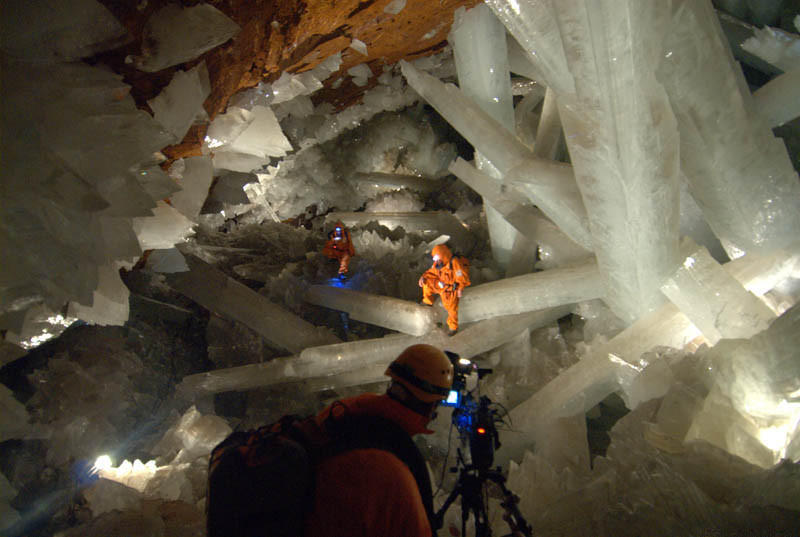
A film-maker walks among 10m long crystals.  All images from stormchasers.

The Naica Mine is a lead and zinc mine reaching some 300m below the surface of Chihuahua, Mexico.  In 2000, miners broke through into a chamber filled with gigantic crystals.

The cave was filled with hot, mineral rich water for the last 500,000 years.  That environment was ideal for crystal development, and the result are selenite (a form of gypsum) crystals that have reached 11m and more than 50 tons.

Mining drained away the water, but the cave remains a challenging environment.  A magma pool nearby keeps the temperature up at 58C (136F), with the humidity up over 90%.  These film-makers needed to wear suits to let them cope; their equipment struggled and the camera broke down at the end of the day.

A cave deep underground that looks like Superman’s fortress of solitude, that says adventure to me.  It also reminds me of Doctor Who’s visit to the cave of the Great One on Metebelis III.  Hmm, and that was a planet he first visited in a story arc revolving around a mine.

Beyond that, the idea that this was something stumbled on by miners is intriguing.  People toiling in already dangerous conditions break through to something unexpected – another cave or something else?  I wonder, what was it that happened to Juan Romero?

Friday, November 12, 2010

Into the unknown

Continuing this spate of posts on caves, a clutch of images from National Geographic.  Fine examples of the magazine’s long history of outstanding photography, all these photos leave me wanting to explore these places myself.  In an imaginary, make-believe kind of way rather than actually abseiling, of course.


Possibly Sotano de las Golondrinas


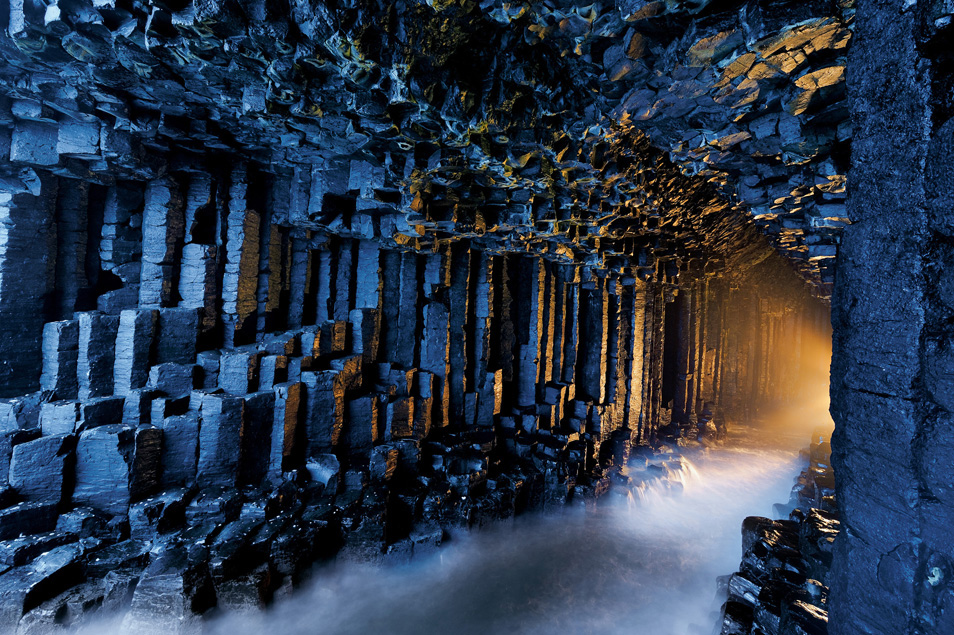
Fingal’s Cave, the outer Hebrides


Sotano de las Golondrinas, Mexico


Majalis al Jinn, Oman


Xkeken Cenote, Yucatan, Mexico

Isometric cave maps

While reading about caves with massive vertical drops, I found a some isometric maps of caves around Mount Velebit in Croatia.  First, Lukina Jama, the deepest pit in Croatia.


Lukina Jama, from the Croation Speleology Server.  Click through for full size.

At the bottom there is a system of ponds that houses one of the largest colonies of subterranean leeches.  Now, what exactly are those leeches feeding on (apart from lost explorers)?

The trogolobitic leech, Croatobranchus mestrovi.

Second, Velebita.  This has the longest single vertical drop – 516m.  I love that this map seems to have included diagrams of where the ropes go, and pictures of trees and boulders at the surface.  Are they like markers to help you find the place: “it’s easy to spot, there’s a big fir tree there and a rock that looks like Groucho Marx’s nose – you can’t miss it”.

Velebita
Small sample from the Velebita map, again from the Croation Speleology Server. Click through for full size.

These caves, and several others, are all clustered around the one location in the Sjeverni Velebit national park.  This cross-section shows just how close they are to each other – shades of the Caves of Chaos?


Cross-section, click through for full size.

The Miao Keng shaft


The 500m deep Miao Keng shaft, image via the Daily Mail.

The area around the mountain village of Tian Xing seems to have an incredible assortment of caves.  It has the four deepest cave systems in China and “numerous 200m+ vertical shafts” including the 491m Miao Keng shaft.  A half a kilometre (1600 feet, for the metrically challenged) of sheer vertical drop.


At the bottom of the shaft, the lights are the cavers’ headlamps.  Via Daily Mail.

The descent down this shaft takes hours, all performed abseiling on a single rope, and this particular team of cavers spent a week exploring the area.  As long as this drop is, it’s not quite the longest in the world: there are several in Croatia and Slovenia that are somewhat longer than it.

Those pictures of the descending cavers are spell-binding.  Descending a shaft like that must take some serious nerve, a real act of faith in the strength of your equipment.  Would your characters have what it takes to face a thousand foot drop into the unknown?  Would they even be able to deal with the logistics of traversing it?

Friday, October 22, 2010

Sprawling monastery and gigantic caverns, part 2.

In part 1 I described the hillside cave-monastery of Vardzia in the eastern European country of Georgia.  Now let’s turn our attention to the second part of the title, the vast cave complex of Krubera (aka Voronya).

The Krubera caves are the deepest yet found (depth measured from the cave entrance rather than against sea-level).  At its lowest point it is 2,191m below its sole entrance, making it the only known cave beyond the 2000m mark, and the total extent of the caves is over 13km.  It was only discovered in 1960 and the initial explorations only descended 60m

Since 2001 teams from the Call of the Abyss project have explored the caves out to their current extent and to do so they need to treat the caves the way alpinists treat mountains.  From the BBC's article on the 2004, 56-member team expedition:

Carrying about five tonnes of equipment, they had to negotiate vertical drops and freezing torrents of water. They were also forced to blast rubble from passages that were critically narrowed or blocked by "boulder chokes".

They set camps at depths of 700m, 1,215m, 1,410m and 1,640m, where they cooked meals, slept up to six people to a tent and worked for up to 20 hours at a stretch.

The cavers kept in touch with the surface base camp by rigging nearly 3km (two miles) of rope strung with a telephone wire.

The level of organisation that these teams have is something that no game I’ve been part of has ever considered.  I also think that it’s interesting to see how many repeated visits the teams make.  They don’t simply go the once, look around, and declare the job’s done; in these huge and complicated environments they make visit after visit, exploring places that they’ve already been to see if they missed opportunities to reach even further and newer sections of the cave.  They spend weeks at a time underground using a variety of techniques to map the area, including using coloured dyes to determine how the water flows through the caves (put purple dye in a stream, and if you don’t see the purple in other parts of the cave, you know the stream is going somewhere else).

Now, the reason that I linked posting these caves and the Vardzia monastery together wasn’t just because they are both in Georgia, but because I first read about each of them in a terrific post on the “architectural speculation” blog BLDGBLOG.  That post was what really put the idea of a blog like this in my head, when towards the end he mentions that there is no connection between the monastery and the caves, but:

… how exciting would it be to discover that Vardzia had, in fact, been constructed as a kind of architectural filter above the stovepipe-like opening of a titanic cave system, and that, 800 years ago, monks alone in the mountains reading books about the end of the world might have sat there, surrounded by fading frescoes of saints and dragons, looking into the mouth of the abyss, perhaps even in their own local twist on millennial Christianity standing guard over something they believed to be hiding far below

I won’t steal any more of his thunder, but in the paragraph after this he throws out an idea that I sincerely hope someone turns into a game.  Enough said, go see for yourself.

Wednesday, October 20, 2010

The sub-surface skyscraper

Open-cut mines dig massive, massive holes out of the earth, leaving behind the problem of how you go about remediating the site once the mine is spent.  Washington University in St Louis student Matthew Fromboluti designed Above Below, a brilliant proposal to take Arizona’s 900 feet deep Lavender Pit Mine:

The empty mine, via evolo.

And build within it an “inverse sky-scraper” as a self-sustaining underground building.

The interior and the surface of Above Below, via evolo.

The holes on the surface allow light to reach the lower levels, while the central column allows warm air to escape from the structure, driving wind turbines near the top.  The lowest level acts as a reservoir to collect rainwater.

Schematic of the interior, again from evolo.

The pictures don’t really suggest how vast this would be.  At 900 feet (274m) deep, that central tower would be the height of a 60-storey building.  The surface covers 300 acres, which is roughly a kilometre wide square.

While the design looks immediately useful as a futuristic location, this had me thinking about that old fantasy trope of dwarves living in mines.  That almost always seems to mean rickety deep mine shafts, but this offers an alternative model.  And the damage to the surface that digging out such a large structure makes could be the cause of enmity between these miners and woodland elves: the dwarves as hard-headed business men, the elves as eco-terrorists.

Friday, September 24, 2010

The sewer divers of Mexico City

Via Edible Geography, stills from a National Geographic video.  Carlos Barrios is lowered into the murky depths

Mexico City has the extraordinary history of being built, essentially, on top of a lake.  The water feeding into it was drained away by the Conquistadors (the better to invade Tenochtitlan) and the modern city gradually grew in its place.  But the city is gradually sinking and as a result some of the city’s 650 kilometres of sewers no longer drain as effectively as they should.  They are terribly prone to clogging and with seasonal thunderstorms that means flooding.

Keeping these floods under control means keeping the sewer pumps free of blockages, and to do that they have a team of divers.  Their job is to go into the sewers while the pumps are still running, find the material that’s causing the problem, and remove it.  Generally that’s just rubbish that’s been swept up off the streets, but as a Washington Post article mentioned it could also be something much worse:

At least there were no human bodies today, like the two he found floating by recently.

…

He never found out who they were, because they were carried off in the flowing waters. The police were not called. The divers, who periodically encounter bodies because sewers are popular spots for dumping murder victims, only call police when they bring a body to the surface.

The cage lowers into the filth.

I imagine that it takes a special kind of person to do this work; apart from the filthy conditions, apart from the occasional encounter with dead bodies, the water is so dark and polluted that they can’t even see.  They inch their way through the sewers feeling ahead of them until they reach the blockage that will typically be up against the blades of a pump that’s still running and start reaching around to try to dislodge it.

We’d love to be able to see down there, but the water is so dirty and it’s got so many particles in it that the light reflects off everything and bounces on your eyes and you still can’t see. Eight hundred watts—one thousand watts even—and I can’t even see my own hand in front of my face. Apart from something that could help me see down there, I can’t think of anything. Fancy things like a robot or a submarine wouldn’t really help with the kinds of things I do. And we’d still be in the same situation: we can’t see anything down there, so we have to feel it

(From Edible Geography)

It is a fabulous scenario for a horror game – who knows what could be hiding down there? – but it’s got me thinking about a fantasy version.  Underground locations are commonplace; underwater locations are much less common but there are some; I can’t think of much at all by the way of games that have combined the two.