Showing posts with label Shadowy figures. Show all posts

Sunday, June 5, 2011

The Stasi scent library

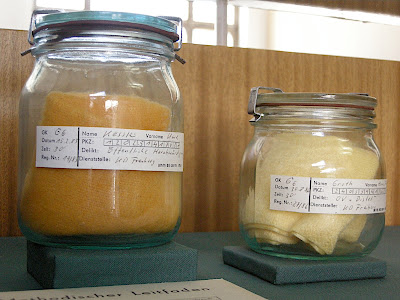
In the Stasi museum at Runde Ecke, in Leipzig, there are many examples of how far the East German secret police were prepared to go to maintain control over their own citizens.  Among collections of stolen mail, covert photographs, and disguises for their agents, there is one especially surprising example:

A row of sealed jars, each containing a seemingly innocuous yellow dust cloth, forms part of the museum's permanent exhibition. But these jars were part of the East German secret police's collection of scent samples used to keep track of dissidents.

[from DW-World.de]
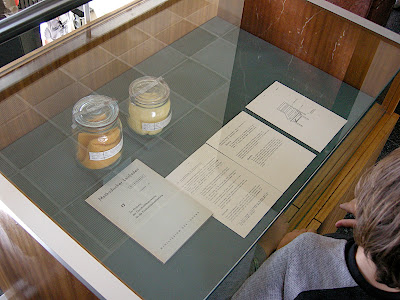

Examples of the scent jars, photos from Maki Ueda

These scent samples were used as a kind of odour fingerprint.  When they got samples of materials being distributed by dissidents – like a flyer or a letter – those samples would have a faint trace of the people’s odour on it.  By matching it against their library of scents, they could identify who had been responsible.

When they found a piece of graffiti or a flyer then they took a dust cloth, which was usually yellow, and left it for a while lying next to the flyers covered by a protective piece of aluminum foil and then they had their sample. The cloth was then sealed in a pickling jar and stored. If the Stasi later came across a suspect in the process of the investigation, they tried to get a sample from this person as well -- of course, secretly. A trained dog was given the two smells, and if they matched, the Stasi had a concrete name.

They would often invite someone in for a talk with the police or other officials, for example, and undercover Stasi officers pretending to be police officers or an administrative person were usually present at this meeting. And while the person sat on the chair in the office, they would be, without knowing it, impregnating a yellow cloth hidden under the seat. When this fictive visit was over, the Stasi officer would then put the cloth in the pickle jar -- and they had their sample.

[from DW-World.de]

A store-room filled with thousands of jarred scent samples sounds would be a fine scene for a rather dark espionage or conspiracy game.  A dimly lit (or windowless) concrete building, row upon row of shelves with neatly labelled jars.  Can they find their own names there?  Loved ones, friends, people they have met?  The articles mention that apart from scents, they collected samples of hair, handwriting, even saliva – could the characters find a little cross-section of their lives?

Of course, you could also play this for laughs.  The characters have to collect scent, hair, saliva samples from various marks.  So they have to ingratiate themselves with the target and get close enough to take some swabs or snip off some hair.  Or break into their house to steal unwashed clothes, pull hair out of drains – but the suspect is at home and is hosting a dinner party, how are they going to talk their way out of this?

Wednesday, October 20, 2010

Mass Observation

Imagine an organisation that covertly photographs and records the conversations of people across the nation, but it’s not the Stasi.  Imagine people documenting the minutia of their day in great detail and sharing it with strangers, but it’s not Twitter.  Imagine that this is all being run by volunteers on a shoe-string budget in 1930s Britain, and you have Mass Observation, “the anthropology of ourselves”.

Mass Observation was a project started in Britain just after the Depression by the unlikely trio of an anthropologist, a film-maker, and a poet.  All three had an interest in uncovering a British culture other than the one transmitted down from traditional authority.  To do this, they proposed to found a new science of observing people as they were in their day-to-day lives.

The data collected would enable the organizers to plot “weather-maps of public feeling.” As a matter of principle, Mass-Observers did not distinguish themselves from the people they studied. They intended merely to expose facts “in simple terms to all observers, so that their environment may be understood, and thus constantly transformed.”

[Caleb Crain, Surveillance Society, The New Yorker]

Starting with nothing but big (and nebulous) plans and high ideals, and with no funding but the money in their own pockets, the trio managed to build a network of correspondents (or “observers”) who would both keep minutely detailed diaries and respond to questionnaires on all manner of subjects.

[B]etween 1937 and 1945 hundreds of people mailed in regular reports of their daily lives. They came from all backgrounds, though young unmarried clerks and schoolteachers were especially well represented. No detail was too trivial. Mass-Observation studied which end of a cigarette people tap before lighting it (fifty-two per cent tap the end they put in their mouths), the nature of women’s revenge fantasies in wartime (cut Hitler into slices for pie; saw off his ankles, sharpen his shins into stakes, and pound him into the earth with a big saucepan), and the number of outdoor copulations on a typical night in the working-class vacation town of Blackpool (four, including one in which an observer participated).

[Caleb Crain in The New Yorker again]

This mass of observing lead to a series of books published on a variety of unusual topics.  The first, May the Twelfth, documented the day of George VI’s coronation with details ranging from an usher at the service smoking to a prostitute soliciting one of the “observers” at the Euston train station.  During the war, they produce The Pub and the People about the activity in the pubs of the northern industrial city of Bolton: we learn that during “a single Thursday night, pubgoers drink, on average, 3.16 pints of beer; on a Saturday, the average goes up to 3.45 pints”.

These books must make for a terrific resource for playing something like Call of Cthulhu in a 30s British setting.  The other fascinating aspect is this trio of characters who manage to arrange this network of informants and mass of data out of nothing.  Essentially they gathered their informants with their own charisma, convincing people that this was a good idea.  I imagine them as something like a benign version of Sax Rohmer’s Dr Fu Manchu, or a sane Mr Wilde from Robert Chamber’s The Repairer of Reputations.

And why not have an organisation like this that isn’t the arch nemesis.  Perhaps they are shadowy, gathering information in secret, but actually with good (albeit confused) motives.  Perhaps rather than being Cthulhu cultists, they are stumbling on evidence of the cult and its activities, but haven’t yet put all the pieces together.