Showing posts with label Natural wonders. Show all posts

Sunday, January 16, 2011

Kombucha tea

Yesterday my brother introduced me to kombucha tea, a drink reputed to have healing properties.  Not being the sorts to just buy ready made bottles of something that they can make themselves at home, he and his wife brew the drink in a large container, and it’s a quite an eye catching process.


Kombucha tea brewing in a jar.  Image from More Intelligent Life.

Like a sourdough mother or a ginger-beer plant, kombucha is brewed by a placing a kombucha “mushroom” into a container of sweetened black tea.  The mushroom eats the sugars in the tea and ferments it into a drink that combines some of the flavours of tea, cider vinegar, and rustic beer.  The mushroom isn’t actually a mushroom, of course, it’s a floating raft of bacteria and yeasts forming a symbiotic organism known as a zoogleal mat.

The floating kombucha mushroom.  Image from Green Tea Today.

Apart from being an interesting element to add to the description of a place in a game, this would also be a cool prop to put out on the table.  Describing the inside of an apothecary shop, the attendant pulls out a jar with a cloudy, sour smelling liquid with some floating collection of organisms floating in it.  At this point, you might reach down and pull up onto the table a jar of kombucha that you’ve prepared.  Pull the mushroom (also called “vinegar mother”) out of the way and pour out cups of the cidery, slightly carbonated drink and offer it to the players.  Or fill a flask with it, and insist that when their characters drink a healing potion, they need to take a swig from the kombucha?

Friday, January 14, 2011

The beaver’s ultimate defence

According to a story dating back to Aesop, beavers were hunted for their testicles.  Somehow, the beavers understood this and so when they realised that escape was impossible, they made a last desperate manoeuvre.  Bending themselves double, they would bite off their own testicles; then the hunters could take the testicles and leave the beavers alone.


An exceptionally flexible beaver attempting to escape hunters.  Image from the British Library, via Medieval Bestiary.

Of course, this is total nonsense.  Much of the science of the ancients was built on the same principles as story-telling, the ideas of what related to what often seemed to be built on the same reasoning that would make sense in a story.  As when a knight in a story finds a sword with a snake inscribed on the blade and concludes that either it will be poisoned or will be deadly to snakes, so too did the ancients see that the seeds from the Echium vulgare resembled snake heads and concluded that it could cure snake-bite.

In this case, it’s a moral tale, related to the bible saying that “if your right hand causes you to sin, cut it off”, or the story of Saint Lucy cutting out her eyes to dissuade an admirer.

This would make quite a scene in a game: the characters are hunting an animal for some part of its body (if the players are too squeamish to hunt for testicles, perhaps the horn, mane, or tail?).  At some point in the chase, the characters find the animal standing at the other side of a clearing just finishing the task of tearing off the very part that they wish to get.  The animal looks at the characters as if to say “there, you got what you came for, now leave me alone” and walks off into the wood.  What would they make of that?  Is it really just an animal if it can make such a decision?  And what might it be hiding in the forest if it’s prepared to cut off parts of its own body protect it?

Saturday, January 8, 2011

K2, the mountain with no name

Among the world’s great mountains, K2 stands out for having a remarkably impersonal name.  Where other mountains had dramatic names like Kangchenjunga, Aconcagua, and Kilimanjaro, K2 has little more than a catalogue number.  And, indeed, that’s just what it was.

In 1856, as part of the Great Trigonometric Survey of India undertaken by the Royal Geographical Society, Thomas Montgomery was mapping the Karakoram range in northern Pakistan (then part of India).  From a base camp atop Mount Haramukh, he was taking a series of exacting measurements of the peaks in the region.  Multiple results from different locations would then be combined to determine the position and height of these mountains.


The 1870 survey map of India, from the archives of the Royal Geographical Society

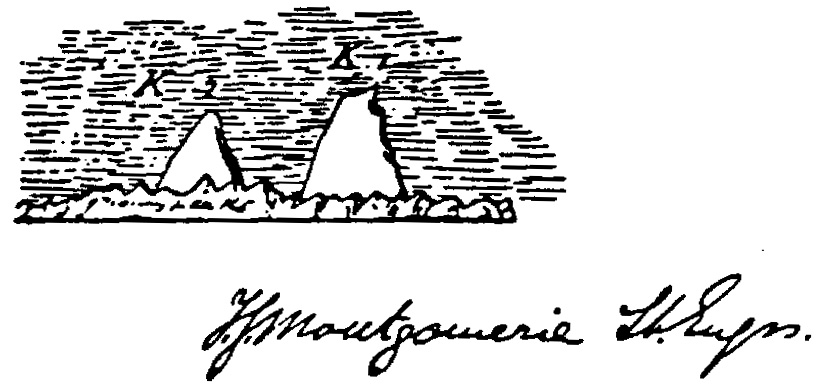
Montgomerie was simply cataloguing the peaks that he observed, ‘K’ for Karakoram and then simply numbering them.  They made sketches of their outlines to help identify which peak was which between all the sets of observations.


Montgomerie’s sketch of K1 and K2, from Wikipedia.

The policy of the survey was to identify the mountains using their local names.  This certainly hadn’t been the case in other surveys, hence Denali and Tahoma became Mt McKinley and Mt Rainier.  (I wonder if the reasons for that policy had something to do with military intelligence, to avoid confusion when getting information from locals?)  K1 was Masherbrum, K3 was Faichan Kangri, K4 & K5 was Gasherbrum I and Gasherbrum II, but what was K2?

It seems that K2 had no name, and likely because it was so remote.  It couldn’t be seen from any of the nearest settlements, and even the glaciers at the entrance to the range only gave fleeting glimpses.  Despite K2 being a good 500 metres taller than any other peak in the entire range, it had seldom been seen and hadn’t earned a name.  There was a proposal to name it after Henry Goodwin-Austen, who explored the region as part of the survey, but the RGS rejected that and the name K2 remains to this day.

What an incredible thought: through the thousands of years of people living so close to one of the grandest mountains in the world, it had remained undetected.  I think that sense of discovery is the essence of the old school megadungeon, that feeling that you’re the first person to see what is hidden there.

Friday, January 7, 2011

Trango Towers

In the north of Pakistan, in the Baltoro Muztagh mountains and not far from K2, the Trango Towers feature several of the most significant granite cliffs in the world.  The eastern face of the Great Trango Tower, the highest peak in the group, features the largest “nearly vertical” drop in the world: 1,340 metres, but not with the true vertical drop of Mount Thor.


Looking across the Baltoro glacier, the Trango group are on the left of this picture.  Image via Evert Wesker.


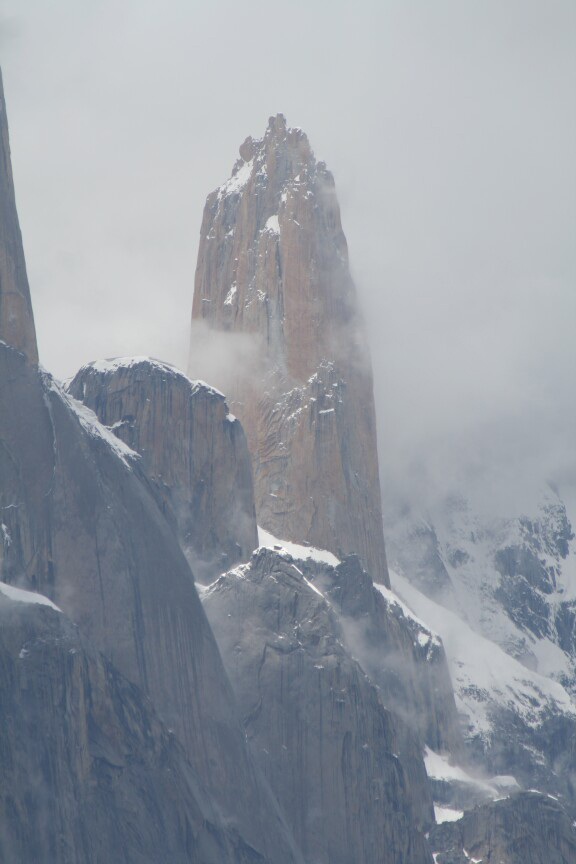
Great Trango Tower.  Image via Askole treks.

The image of those towers rising up out of the Baltoro glacier is very impressive; especially when you consider that the glacier itself is up at 4,000m and yet they still rise a kilometre above that.  What really caught my eye was that among this group of mountains is one particularly striking peak with the equally striking name of Nameless Tower.


No attribution, but image found via these forums.


Image via Todd Skinner


Image via Todd Skinner

Anything that we might call ‘nameless’ immediately brings Lovecraft to mind.  Those towering cliffs all remind me greatly of scenes from Lovecraft’s The Dream-Quest of Unknown Kadath (I must get around to reading At the Mountains of Madness, which I imagine is rife with these places).  The Plateau of Leng and the mountains separating it from Inganok, the mountain Ngranek (although that was a solitary extinct volcano), even the great carved mountains that protect Kadath.  And there is also the granite island that was referred to as “that nameless rock”:

On the twentieth day a great jagged rock in the sea was sighted from afar, the first land glimpsed since Aran’s snowy peak had dwindled behind the ship. Carter asked the captain the name of that rock, but was told that it had no name and had never been sought by any vessel because of the sounds that came from it at night. And when, after dark, a dull and ceaseless howling arose from that jagged granite place, the traveller was glad that no stop had been made, and that the rock had no name. The seamen prayed and chanted till the noise was out of earshot, and Carter dreamed terrible dreams within dreams in the small hours.

That final image of Nameless Tower by night, with that lonely light peering out, gives me the distinct feeling of a place where people are not meant to be, where we are not welcome.  In a sense, the advances that climbing technique and equipment have made that allows them to scale all of these places – so that now the challenge is to find newer, more difficult ascents – has removed some of the feeling that people must have had in previous generations of places that were simply inaccessible, mysteries that could only be penetrated in the imagination.

Wednesday, November 17, 2010

Glowing trees, a thousand blooms


Trees, but not actually glowing ones; image via Engadget

A pair of interesting plant related stories came out recently.  First, researchers in Taiwan reported that they were able to stimulate plant’s leaves to produce a red glow.  Their work involved infusing the leaves with gold nanoparticles, apparently shaped like sea-urchins and “dubbed nano-sea-urchins or NSUs”.  The researchers are hoping to refine the technique to the point that suitably treated street trees could replace street lights, so they clearly believe that the glowing trees are capable of producing a significant amount of light.

I love the idea of a town bathed in the light of their glowing trees.  Perhaps it’s actually part of the forest, the town is built right in the middle of a dense forest within a section of bio-luminescent trees.  Or a secret glade of trees, even a single special tree, that glows at night.  A sacred place, perhaps, with a temple of some kind and a gathering place for worshippers.  And it could work in either a futuristic setting (where it would be ecological high technology), or fantasy (druidic or elven mystical rites to ‘feed’ gold-dust to the trees).

Would the effect on the trees be permanent, or would they require constant replenishment to maintain their glow?  Would the people need a constant supply of gold to feed to the trees?  Would the trees be evergreens or deciduous?  If they’re deciduous, what happens to the leaves themselves – are they allowed to decompose and feed the trees again, are they worth something to a thief?  And if they’re deciduous, would that mean going without their light over winter?

The other story was of a master chrysanthemum grower who has produced a 1000-bloom plant.


The thousand bloom plant, via Gizmodo

The plant was produced by a long system of pinching and training the shoots, with the whole plant fitted into a metal structure to preserve the shape.  This doesn’t suggest some use to me beyond simply looking spectacular, but sometimes that is use enough.  Insert something like this into the halls of some royalty, or have this as one of these glowing trees – what if the flowers, rather than the leaves, glow at night?