Showing posts with label Medical marvels. Show all posts

Sunday, January 16, 2011

Kombucha tea

Yesterday my brother introduced me to kombucha tea, a drink reputed to have healing properties.  Not being the sorts to just buy ready made bottles of something that they can make themselves at home, he and his wife brew the drink in a large container, and it’s a quite an eye catching process.


Kombucha tea brewing in a jar.  Image from More Intelligent Life.

Like a sourdough mother or a ginger-beer plant, kombucha is brewed by a placing a kombucha “mushroom” into a container of sweetened black tea.  The mushroom eats the sugars in the tea and ferments it into a drink that combines some of the flavours of tea, cider vinegar, and rustic beer.  The mushroom isn’t actually a mushroom, of course, it’s a floating raft of bacteria and yeasts forming a symbiotic organism known as a zoogleal mat.

The floating kombucha mushroom.  Image from Green Tea Today.

Apart from being an interesting element to add to the description of a place in a game, this would also be a cool prop to put out on the table.  Describing the inside of an apothecary shop, the attendant pulls out a jar with a cloudy, sour smelling liquid with some floating collection of organisms floating in it.  At this point, you might reach down and pull up onto the table a jar of kombucha that you’ve prepared.  Pull the mushroom (also called “vinegar mother”) out of the way and pour out cups of the cidery, slightly carbonated drink and offer it to the players.  Or fill a flask with it, and insist that when their characters drink a healing potion, they need to take a swig from the kombucha?

Friday, November 5, 2010

The plague doctors


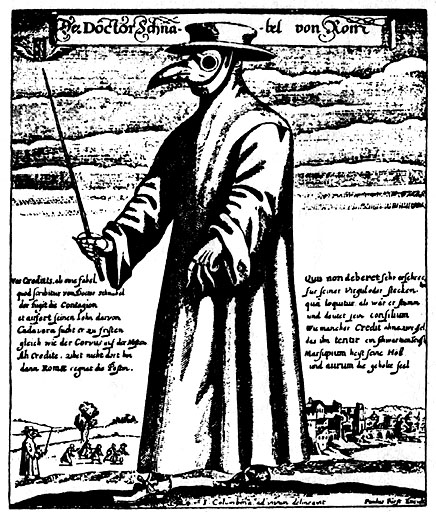
‘Doktor Schnabel von Rom’ (beak doctor of Rome), via Wikipedia

Like the church, cities had to deal with the growing numbers of people ill with the plague.  But, like the priesthood, doctors were hardly clamouring to get the chance to spend time with the most dangerous disease they had seen.  A new group of doctors were hired – the plague doctor.  Often they were second-rate doctors who were not able to run a successful practice (a case of “those who can, do; those who can’t, become plague doctors”, I guess).  Not that this really mattered as 14th century medicine had no answer to the plague.

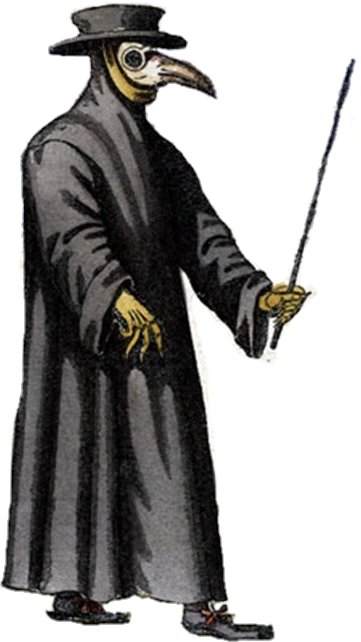
The most remarkable feature of the plague doctors was their beak costume.  Their wide-brimmed hat was a symbol of their profession; the long overcoat, leggings, and gloves were made from waxed leather; they carried a cane to use for examining the patient rather than touching them.  Their beak mask contained fragrant flowers, herbs or oils, all intended to ward off the noxious vapours that they believed to be responsible for spreading the disease.  The sight of them at the door of your house must have been terrifying, a sure sign that the end is near.


Colour version of the beak doctor engraving, via Wikipedia

The plague doctors may have had little effect on the plague, but they were paid very well for their services.  Giovanni de Ventura in Pavia received a salary of 30 florins a month, which was several times the wage that a skilled person would receive.  The doctors were subject to lengthy contracts that obliged them to visit the sick several times a day, to remain in quarantine, and to not enter the town without being accompanied by a representative of the town.

I love the idea of the healers in a city being dressed in costumes like these.  Perhaps with some bird-like mannerisms, tilting their head from side to side as they look at you, saying “hmmm, hmmm” like a crow’s ‘caw’ or dove’s ‘coo’, poking and proding with their canes.

Thursday, November 4, 2010

Life in the time of plague

There are several periods in history whose events led to radical changes in society and whose influence would continue to be felt for generations, for even hundreds of years.  Narrowing our focus down to Europe, we might choose: the rise and fall of the Roman Empire; the spread of Christianity and then of Islam, and the Reformation; the Renaissance and the Enlightenment; the French Revolution and the two World Wars.  These were all human events, the result of people’s actions, but there was one natural event whose influence was at least as great: the arrival of the Black Death.


Image from the Toggenburg Bible, via Wikipedia

The plague was incredibly devastating to the population of Europe.  During the great outbreak of 1348-51, as much as 60% of Europe’s population died.  If you contracted the disease, there was a better than 90% chance that it would kill you, and the disease was terribly contagious.  The spread of the plague wasn’t even, though, with some places suffering far more than others:

The trend of recent research is pointing to a figure more like 45% to 50% of the European population dying during a four-year period. There is a fair amount of geographic variation. In Mediterranean Europe, areas such as Italy, the south of France and Spain, where plague ran for about four years consecutively, it was probably closer to 75% to 80% of the population. In Germany and England ... it was probably closer to 20%

[historian Phil Daileader, quoted on Wikipedia]

Those numbers are bafflingly large.  Look around where you live and try to imagine what would happen if half or three-quarters of the people there were to die in the space of four years.

One thing that’s not commonly understood about the plague is that it wasn’t a single event.  The 1350 plague was only the most spectacular of a long series of plague outbreaks over then next 400 years.  These later outbreaks were more localised – to a particular city or region – but each saw the same horrific mortality rate.

The identity of the plague is still a matter of debate; it’s widely believed to have been the bubonic plague, but there are no solid medical records or samples that can be used to diagnose it.  Even the name “the Black Death” was only attached in the 16th century, back in the 14th century they called it “the Great Pestilence”, “the Great Plague”, or “the Great Mortality”.

Although they don’t tend to make much of an appearance in fantasy literature (compared to, say, war), plague and famine were part of the back-drop of life in the Middle Ages.  It’s only really in the 20th century that this started to change.  Over the next few days we’ll look at some specific things that the plagues caused or changed in Europe.  In the meantime, just ponder what life must have felt like in the shadow of the plague – it’s something that I don’t think many people consider as a possible backdrop for a game.

[I suppose that I should actually read Love in the Time of Cholera before I go punning its name.  I do like the ‘magical realism’ of Gabriel Garcia Marquez, his One Hundred Years of Solitude was a breathtaking book.]

Saturday, October 23, 2010

Antibiotic beer

While recovering from a cold, I recalled reading that Ancient Nubians brewed antibiotic beer:

A chemical analysis of the bones of ancient Nubians shows that they were regularly consuming tetracycline, most likely in their beer. The finding is the strongest evidence yet that the art of making antibiotics, which officially dates to the discovery of penicillin in 1928, was common practice nearly 2,000 years ago.

…

“We tend to associate drugs that cure diseases with modern medicine,” Armelagos says. “But it’s becoming increasingly clear that this prehistoric population was using empirical evidence to develop therapeutic agents. I have no doubt that they knew what they were doing.”

…

Even the tibia and skull belonging to a 4-year-old were full of tetracycline, suggesting that they were giving high doses to the child to try and cure him of illness, Nelson says.

Essentially the research says that these ancient Africans knew how to produce an antibiotic that was only rediscovered in the 1940s.  I think that makes a nice variation on the usual “potion of healing”, and is something of a double-edged sword: it can help cure sick characters, but at the cost of getting them drunk.  Or what if all these potions are just charlatanry and potions of healing, curing, courage, strength etc are just flasks of brandy?  They pop the cork, take a big draught and think “Yes, I do feel stronger”.