Showing posts with label Death and disease. Show all posts

Wednesday, February 9, 2011

Reburying the dead

[Via BLDGBLOG]  The British government has given their archaeologists a very difficult condition to work with: all human remains must be reburied within 2 years of being excavated:

The dispute centres on legislation introduced by the Ministry of Justice in 2008 which requires all human remains excavated at digs in England and Wales to be reburied within two years, regardless of their age. The decision, which amounts to a reinterpretation of law previously administered by the Home Office, means scientists have too little time to study bones and other human remains of national and cultural significance, the academics say.

…

The ruling applies to any pieces of bone uncovered at around 400 dig sites, including the remains of 60 or so bodies found at Stonehenge in 2008 that date back to 3,000BC. Archaeologists have been granted a temporary extension to give them more time, but ultimately the bones will have to be returned to the ground.

[from The Guardian]

No doubt the government has reasons for this imposition that they aren’t prepared to reveal!  Is it that they want to restrict how long the scientists may study these early remains so that they cannot learn some shocking truth (such as that they are really white apes)?  Or is it that the bodies must be returned to the earth to prevent something from happening?  Or even that someone with influence over the government requires the bodies to return to Stonehenge soon so that some ritual may be completed?

And the law covers all digs in England and Wales, but not Scotland.  What’s going on there – are they trying to encourage more activity in the north?  Could there be something that someone wants uncovered that isn’t getting sufficient attention?

Another thought occurs to me, it would be an interesting purpose in life for a priestly character in a fantasy game not just to be a foe of the undead, but to give these misused corpses a proper burial.

Friday, November 5, 2010

The plague doctors


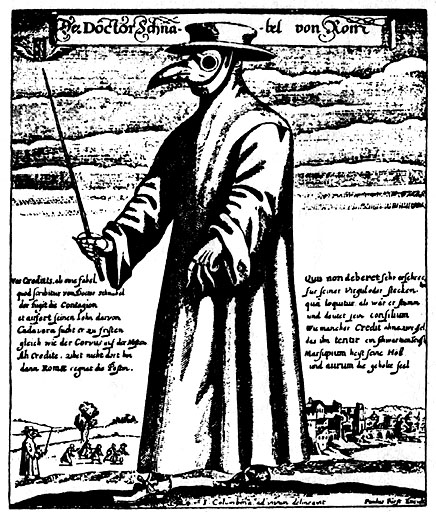
‘Doktor Schnabel von Rom’ (beak doctor of Rome), via Wikipedia

Like the church, cities had to deal with the growing numbers of people ill with the plague.  But, like the priesthood, doctors were hardly clamouring to get the chance to spend time with the most dangerous disease they had seen.  A new group of doctors were hired – the plague doctor.  Often they were second-rate doctors who were not able to run a successful practice (a case of “those who can, do; those who can’t, become plague doctors”, I guess).  Not that this really mattered as 14th century medicine had no answer to the plague.

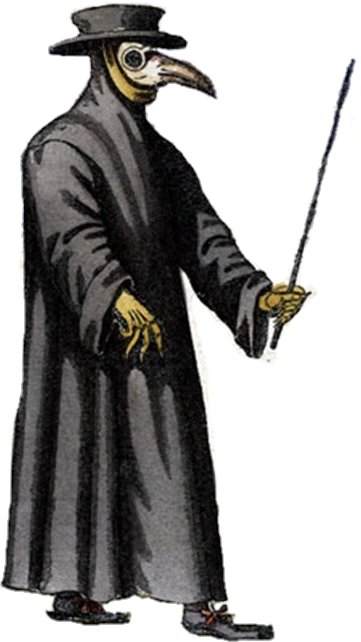
The most remarkable feature of the plague doctors was their beak costume.  Their wide-brimmed hat was a symbol of their profession; the long overcoat, leggings, and gloves were made from waxed leather; they carried a cane to use for examining the patient rather than touching them.  Their beak mask contained fragrant flowers, herbs or oils, all intended to ward off the noxious vapours that they believed to be responsible for spreading the disease.  The sight of them at the door of your house must have been terrifying, a sure sign that the end is near.


Colour version of the beak doctor engraving, via Wikipedia

The plague doctors may have had little effect on the plague, but they were paid very well for their services.  Giovanni de Ventura in Pavia received a salary of 30 florins a month, which was several times the wage that a skilled person would receive.  The doctors were subject to lengthy contracts that obliged them to visit the sick several times a day, to remain in quarantine, and to not enter the town without being accompanied by a representative of the town.

I love the idea of the healers in a city being dressed in costumes like these.  Perhaps with some bird-like mannerisms, tilting their head from side to side as they look at you, saying “hmmm, hmmm” like a crow’s ‘caw’ or dove’s ‘coo’, poking and proding with their canes.

The Art of Dying


Plate from ‘The Art of Living Well, and of Dying Well’, from the Library of Congress

The Black Death had a significant impact on the church.  The priesthood suffered as many deaths as any other part of society: of the 600 bishops, 230 died during the plague, 13 “disappeared” and there are 20 who cannot be accounted for.  These senior clergymen would have been relatively isolated by comparison with the huge majority of the priests.  They were expected to give last rites and hear a final confession for the dying, which meant being exposed to the disease.  It reached the point that the priests simply refused to visit the sick, which would have been a real problem for a deeply religious culture: without a final confession, would they miss their place in the afterlife?

To make matters worse, the lost priests needed to be replaced, and to do that the church had to lower their standards.  They ordained many people who would have been passed over in the past, people who had limited understanding of the faith they represented.  And, of course, this compounds the problem of having so many people dying: more people than ever needed last rites, but if you actually managed to get a priest to visit they may not know what needs to be done.

People had to take matters into their own hands, and to do that they needed instructions on what was expected.  To fill that need came the Ars Moriendi, the Art of Dying.  These were books that set out what a dying person should do, what temptations they should resist, what prayers they should make to give them passage into heaven.

Devils tempt a dying man with crowns, via Wikipedia

These books were particularly popular with the growing middle-class, who could both read and afford to buy the book.  The advice in the books may also have become part of the noblesse oblige, the duty that the lords had to care for their serfs.  In the absence of priests, it was the responsibility of a lord to guard his serfs’ souls.  The church didn’t exactly sanction these texts and they weren’t responsible for making them.  After all, the church wasn’t known for giving away something that kept them important in their society.

Suppose in your game world that the dominant religion has been struck by a catastrophe, something that prevents them from aiding all of their faithful.  The gap is filled by unofficial books of religious instructions.  Perhaps these books are incorrect, even malicious – what if they were written to deceive people and that by following them they are participating in something terrible?

[You can see more about the Ars Moriendi in this paper at the University of Ottawa]

Thursday, November 4, 2010

The Dance of Death


The Dance of Death by Michael Wolgemut, via Wikipedia

The Great Plague was an indiscriminate killer.  Certainly it affected the poor (especially the urban poor) the most, but the wealthy, the nobility, and the clergy were not spared.  Nowadays there are differences in the quality of medical care that the wealthy would have access to, but 600 years ago the only advantage they had was being able to flee an outbreak.  It was a great leveller: rich and poor alike could be victims to it.

This gave rise to image and tales of the Dance of Death: Death leading leading people of all walks of life, from emperors and popes to peasants and children, to the grave.  Frequently it would show living people being taken by the hand by skeletons, as if in a dance, while Death plays a flute.


Image from Antiquarian Booksellers Assoc.

One thing that’s striking about these images is that the tone is not altogether morbid.  The message may be “no one will be spared, death is inevitable”, but the skeletons seem to be laughing, positively jubilant.  Even the victims don’t see terribly upset; perhaps when it’s time for you to go, it would be best to have one last dance before the end.

So here’s an option to add to our games: a death-cult with a sense of humour.  So many times the death imagery that appears in a game is of a very simple sort – everything’s bleak and horrible, the clergy are all sombre and/or insane.  Instead, they could have a rather dark sense of humour, that they “remember that the last laugh is on you” (and they could be insane and have a sense of humour).

For that matter, the Danse Macabre was a Christian image used to encourage people to prepare themselves for death.  They weren’t worshipping death, just reminding people that it was inevitable.  So take a look at the pantheon in your favourite setting and ask which of the gods might want to remind people that “death comes as an end”.

Life in the time of plague

There are several periods in history whose events led to radical changes in society and whose influence would continue to be felt for generations, for even hundreds of years.  Narrowing our focus down to Europe, we might choose: the rise and fall of the Roman Empire; the spread of Christianity and then of Islam, and the Reformation; the Renaissance and the Enlightenment; the French Revolution and the two World Wars.  These were all human events, the result of people’s actions, but there was one natural event whose influence was at least as great: the arrival of the Black Death.


Image from the Toggenburg Bible, via Wikipedia

The plague was incredibly devastating to the population of Europe.  During the great outbreak of 1348-51, as much as 60% of Europe’s population died.  If you contracted the disease, there was a better than 90% chance that it would kill you, and the disease was terribly contagious.  The spread of the plague wasn’t even, though, with some places suffering far more than others:

The trend of recent research is pointing to a figure more like 45% to 50% of the European population dying during a four-year period. There is a fair amount of geographic variation. In Mediterranean Europe, areas such as Italy, the south of France and Spain, where plague ran for about four years consecutively, it was probably closer to 75% to 80% of the population. In Germany and England ... it was probably closer to 20%

[historian Phil Daileader, quoted on Wikipedia]

Those numbers are bafflingly large.  Look around where you live and try to imagine what would happen if half or three-quarters of the people there were to die in the space of four years.

One thing that’s not commonly understood about the plague is that it wasn’t a single event.  The 1350 plague was only the most spectacular of a long series of plague outbreaks over then next 400 years.  These later outbreaks were more localised – to a particular city or region – but each saw the same horrific mortality rate.

The identity of the plague is still a matter of debate; it’s widely believed to have been the bubonic plague, but there are no solid medical records or samples that can be used to diagnose it.  Even the name “the Black Death” was only attached in the 16th century, back in the 14th century they called it “the Great Pestilence”, “the Great Plague”, or “the Great Mortality”.

Although they don’t tend to make much of an appearance in fantasy literature (compared to, say, war), plague and famine were part of the back-drop of life in the Middle Ages.  It’s only really in the 20th century that this started to change.  Over the next few days we’ll look at some specific things that the plagues caused or changed in Europe.  In the meantime, just ponder what life must have felt like in the shadow of the plague – it’s something that I don’t think many people consider as a possible backdrop for a game.

[I suppose that I should actually read Love in the Time of Cholera before I go punning its name.  I do like the ‘magical realism’ of Gabriel Garcia Marquez, his One Hundred Years of Solitude was a breathtaking book.]