Showing posts with label Ancient past. Show all posts

Wednesday, February 9, 2011

From Blackfriars to booksellers

With Bookhounds of London going to print right about now, it’s rather timely to see this story of a bookstore built in a 750 year old Dominican church.
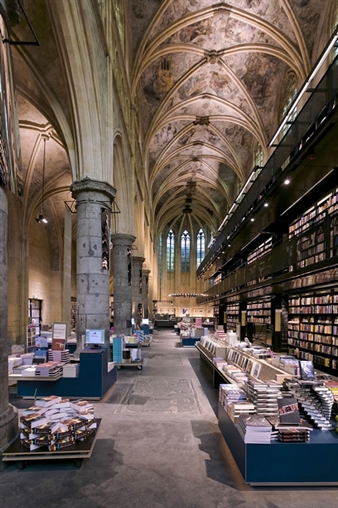

From the store’s Flickr stream.

Whether you’re religious or not, this old Dominican church will certainly bring you the enlightenment you’ve been seeking. After months of renovation this magnificent structure originally constructed in 1294 has opened its doors to the public as a “brand new” bookstore in the heart of Maastricht. …

Dating back to the 13th century, the structure was a Dominican church until Maastricht was invaded by Napoleon in 1794 and the group was forced out of the country. Since that point it has been briefly used as a parish, then a warehouse, then an archive, then a giant parking lot for bicycles (not such a terrible idea) and finally made over into a bookstore.

One thing that strikes me as slightly odd is that while the whole design looks really classy, the crucifix shaped reading table in the nave seems a bit kitsch.


From Crossroads magazine.

Aside from this rather marvellous bookstore, what other things might be put in a disused church?  As the article mentions, this church has also been a warehouse and bike parking-lot, and there are many other churches that have become nightclubs (so many that it’s something of a cliché).  Might a church have become a hostel, a hospital, or even a home?  Might it be a factory, a restaurant, or a school?  Or perhaps one of those discount stores that seem to pop-up in malls to fill empty store-fronts.  And wouldn’t it surprise the new tenants to learn that the treasure of Abbot Thomas was still hidden there?

Reburying the dead

[Via BLDGBLOG]  The British government has given their archaeologists a very difficult condition to work with: all human remains must be reburied within 2 years of being excavated:

The dispute centres on legislation introduced by the Ministry of Justice in 2008 which requires all human remains excavated at digs in England and Wales to be reburied within two years, regardless of their age. The decision, which amounts to a reinterpretation of law previously administered by the Home Office, means scientists have too little time to study bones and other human remains of national and cultural significance, the academics say.

…

The ruling applies to any pieces of bone uncovered at around 400 dig sites, including the remains of 60 or so bodies found at Stonehenge in 2008 that date back to 3,000BC. Archaeologists have been granted a temporary extension to give them more time, but ultimately the bones will have to be returned to the ground.

[from The Guardian]

No doubt the government has reasons for this imposition that they aren’t prepared to reveal!  Is it that they want to restrict how long the scientists may study these early remains so that they cannot learn some shocking truth (such as that they are really white apes)?  Or is it that the bodies must be returned to the earth to prevent something from happening?  Or even that someone with influence over the government requires the bodies to return to Stonehenge soon so that some ritual may be completed?

And the law covers all digs in England and Wales, but not Scotland.  What’s going on there – are they trying to encourage more activity in the north?  Could there be something that someone wants uncovered that isn’t getting sufficient attention?

Another thought occurs to me, it would be an interesting purpose in life for a priestly character in a fantasy game not just to be a foe of the undead, but to give these misused corpses a proper burial.

Sunday, December 5, 2010

The cenotes of Yucatan

If you look at a map of Mexico’s Yucatan Peninsula, a keen eye may notice that although it is located in the tropics, and therefore receives quite a bit of rain in its wet season, there are no major lakes or rivers to speak of, especially to the north.  There is water there, though, flowing underground through aquifer and cave systems known as cenotes.

Since Mayan times, people living in the Yucatan have relied on the cenotes as their source of drinking water.  Growing population in the region have obliged the government to make environmental assessments of the area, and that hydrological surveys of the cenotes.  As a result, the full extent of these underground water systems are becoming apparent.  Two of the systems in the region – Ox Bel Ha and Sac Actun – trade the title of the longest underground river in the world, each having over 180km of explored passageways. You can see an older map of Ox Bel Ha at the site of the group who did the first explorations.


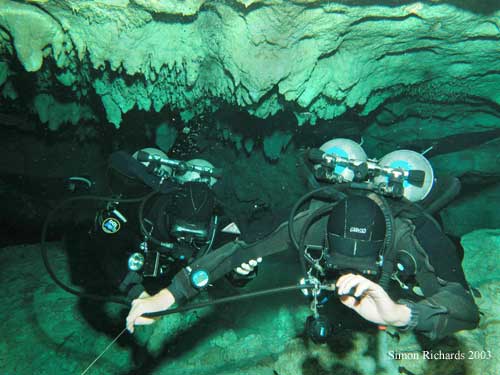
Exploring a cenote, image from Cave-Exploration.com

Exploring the cenotes combines the dangers of diving with the challenges of caving.  The air in their tanks limit how long they can remain in the cave at one time, and the dark, narrow passages give many chances to become lost or stuck.


Exploring a cenote, image from Cave-Exploration.com

The explorers have found numerous relics in the caves, some supposed to be significantly older even than the Mayan culture, perhaps as old as 9,000 years.  They are thought to have been the centre of religious traditions in the area, with the Sacred Cenote of Chichen Itza possibly the site of human sacrifices to their rain god Chaac.

The cenotes have a connection to an even earlier history than that, far earlier than anything from human history.  In the north of the peninsula, many of the cenotes form a distinct ring, following the rim of the Chicxulub crater, the site of an asteroid impact from some 65 million years ago, and a candidate for the cause of the great dinosaur extinction.

Prehistoric geology, ancient human rituals, the encroachment of modern society.  Could the Mayans have been sacrificing not so much to a god in the skies as to a predator under their feet?  A predator that has been there for millions of years.  Shades of Colour out of space, perhaps.

Monday, November 1, 2010

The church with a fossil in its walls

Via BLDGBLOG comes the story of a church in northern Italy, the Cathedral of St. Ambrose in Vigevano, whose marble balustrade holds the fossilized skull of a dinosaur.


The balustrade, image via Discovery news

The skull in the balustrade is visible because it was cut in two, leaving a cross-section of it “like a CT scan”.  To an amateur like myself, the skull is hard to make out, but the experts say that it “clearly shows the cranium, the nasal cavities, and numerous teeth”.


The skull in the balustrade, via Discovery News

As BLDGBLOG explains, the bright red marble comes from a quarry that’s known to have many fossils within it:

The rock itself—called Broccatello—comes from a fossil-rich quarry in southern Switzerland and dates back to the Jurassic. According to the book Fossil Crinoids, "The Broccatello (from brocade) was given its name by stone masons; this flaming, multicoloured 'marble' has been used in countless Italian and Swiss baroque and rococo churches"—implying, of course, that other fossil finds are waiting to be found in Alpine baroque churches. "In the quarries of Arzo, southern Switzerland," the book continues, "crinoids [the fossilized bodies of ancient marine organisms] account for up to half of the bulk of the Broccatello, which is usually a few metres thick."

Imagine a church or a temple whose walls were made from marble housing the remains of some ancient cataclysm.  Is the church related to them somehow, built to preserve their memory or to maintain a reminder of the price of wickedness?  Or is it a coincidence and there is no real connection, the church perhaps built some story around the fossils, but in fact they have no idea what they have?  Could something be preserved and waiting within the walls: the ones that were cut through and exposed are destroyed, but the intact ones within still capable of emerging?  Or has the stone not left the quarry yet, the masons have just uncovered the skeletons and panicked?

Thursday, October 21, 2010

Sprawling monastery and gigantic caverns.

The eastern European country of Georgia is home to a pair of remarkable places: the Krubera Cave, the deepest caves in the world, and the hillside monastery of Vardzia.  Vardzia was originally both built into a hillside, digging caves into the rock, and built out alongside the rock-face.  It was devastated by an earthquake that destroyed most of the external structure, but exposed the structure within.

Photos via wikipedia

The wikipedia entry claims that the monastery would have been 6,000 rooms spread across 13 levels; even now there are still some 300 rooms.

I really like the three-dimensional quality of the layout too: there are levels and partial levels, there are stairs that skip a whole (or multilple) levels, there appear to be many vertical connections as well as lateral.

Notice too that many of the stairs end right where the next begin, in contrast to so many dungeon maps where having arrived at one level you must search for the entrance to the next.  It’s also interesting that the building stretches a long way across and up the hillside, but not very far into it.  In all this layout, very tall and narrow, is quite different to the shallower, broader maps of my youth.

Photo via Wikipedia

Lest these images fool us into thinking that the monastery was a primitive one, let’s finish with some showing remnants of the fine stonework and mosaics that once covered this whole structure.


All images via wikipedia

Thursday, September 16, 2010

The tunnels of Chicago

Artificial caverns under Chicago.  Image via BLDGBLOG and Tunneling Online

Big cities produce, and need, big infrastructure.  Chicago is built in a location that has significant problems with flooding, and in response the city has been building a huge network of storm-drains and sewers at a grand scale.  The TARP (Tunnels and Reservoir Program) project has now built a little over 100 miles of tunnels under the city, varying in width from 8 to 35 feet wide, ultimately leading to reservoirs that will contain billions of gallons of fluids.  And in addition to this, some of the tunnels connect back into a further 60 miles of freight tunnels.

The idea of the “megadungeon” has made something of a return to respectability, but in my mind there is still that nagging doubt about how exactly a largely underground location would come about.  Projects like this suggest a potential origin story – they are remnants of an advanced former civilization.  Post some ancient apocalypse, the city is gone, but its hidden bones remain.

If you think about the areas that have typically been called a “megadungeon”, they will hardly scratch the surface of the monumental scale of a project like this.  Beyond the simple number of 106 miles of tunnels, consider the number of access points or connections back to the service that the system must have as well.  Imagine a tunnel that you would take a day to travel down, and that you could march along it 6 abreast.  Or reservoirs with volumes measured in the hundreds of millions of cubic feet (imagine a cube 300’ x 300’ x 300’, that’s the kind of volume we’re talking about).

Tuesday, September 14, 2010

Altneuschul, Prague – origin of the Golem

via Atlas Obscura

The Altneuschul – literally the “Old New Synagogue” – has a host of stories around it.  Built in Praguue in 1270 AD, it is the oldest surviving Synagogue in Europe.  But as old as it is, it has some claims on being older still, as there is a tradition that believes it contains stones taken from the Temple of Jerusalem.  That would put it in a tradition that stretches back to King Solomon.

But it is most famous for the story of the Golem.  In 1580, so the story goes, in order to protect the Jewish people in the ghettos of Prague from attacks, rabbi Judah Loew ben Bezalel built a clay statue that he brought to life.  The golem then defended the people from their enemies, before turning so violent that it had to be stopped.  According to this story, the golem remains in the attic of the synagogue.  Sadly, the story doesn’t have as old a history as the building itself, and likely originated in the 19th century.

The building has that powerful pull on the imagination of the very old.  Not only is it more than 700 years old, but it may indeed embody components that are far older still.  There is also something interesting about the story of the golem in that it is created to protect the community (even if it eventually goes off the rails).  I can’t think of a game that I’ve seen where the outcome was “let’s build some sort of magical protector” rather than just wading in and doing all the killing yourself.  Indeed, if something like a golem showed up, it’s an adversary to deal with rather than something to create for a role.  Is that the fault of the game, or the gamers?  I think a bit of both.

Tuesday, September 7, 2010

The bleeding glacier

blood falls Photo by Peter Rejcek, from photolibrary.usap.gov

The Taylor Glacier in Antartica’s dry valleys sports a blood-red waterfall some five storeys tall.  As described at Atlas Obscura, the source is a lake that was trapped by the ice some 2 million years ago.  The lake’s water is very saline, which I presume is why it didn’t freeze, and rich in iron, which produces the striking colour.  The falls are the result of a fissure in the glacier, which allows the water to ooze out.  And perhaps most incredible of all, the lake is host to a colony of microbes still living there, without light, without (much) heat, isolated from the rest of the world for all that time.

The image of a glacier in a frozen landscape oozing blood is tremendously evocative.  Imagine in a place where the predominant colours are white, black, and grey, suddenly against a huge chalk-coloured wall of ice there is a brilliant red gash.  Equally evocative is the idea of a glacier as something that can keep something hidden for millions of years, literally for so long that there is no record or memory of it being there.

There are obvious connections to H. P. Lovecraft’s At the Mountains of Madness, or to movies like The Thing (based off John Campbell’s 1938 novella Who goes there?).  In each of these, something has ended up covered by ice by more-or-less accidental circumstances, what if something was deliberately sealed beneath a glacier?  In a fantasy setting, could some ancient creature or culture be deemed so wicked or dangerous that magical or divine powers bury it under the ice?  Now the ice thins and a danger long forgotten returns once more – would you need to find means to defeat it, or to replace the ice over it and bury it once again?